Vectra#
An opinionated, open-source LaTeX CV and résumé system for research, academia, and professional applications. Vectra combines a polished fixed design, modular content files, extensive documentation, reproducible examples, and print-friendly PDF output.
Overview#
Vectra stands for Versatile Experience and Career Template for Research and Academia.
Vectra is built for users who want a polished academic CV or research-oriented resume without spending time adjusting LaTeX formatting.
It is suitable for:
- Academic CVs
- Research resumes
- Graduate school applications
- Fellowship applications
- Research assistant applications
- Internship applications
- Personal academic websites
- Professional self-presentation
The template is designed around a modern academic CV layout:
- Single-column body
- Adaptive right-aligned metadata for dates, terms, and locations
- Clean section titles with subtle rules
- Compact but readable spacing
- Black-and-white print-friendly style
- Machine-readable PDF output
- Minimal visual distractions
- No icon dependency in the default style
Preview#
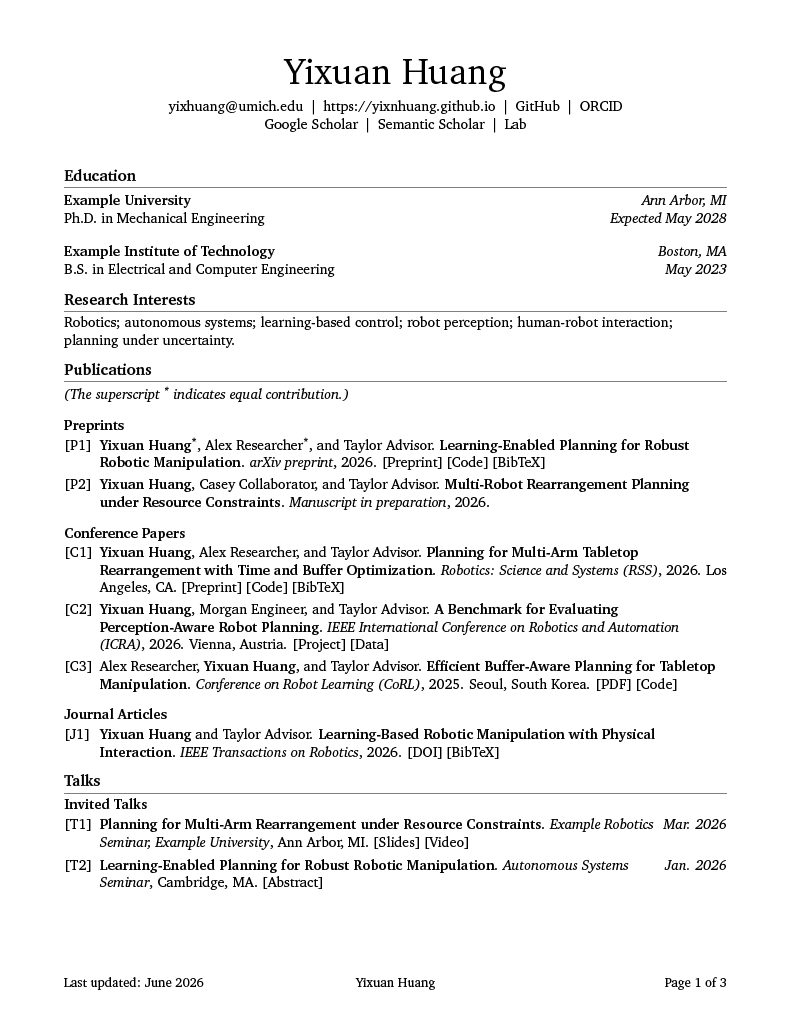
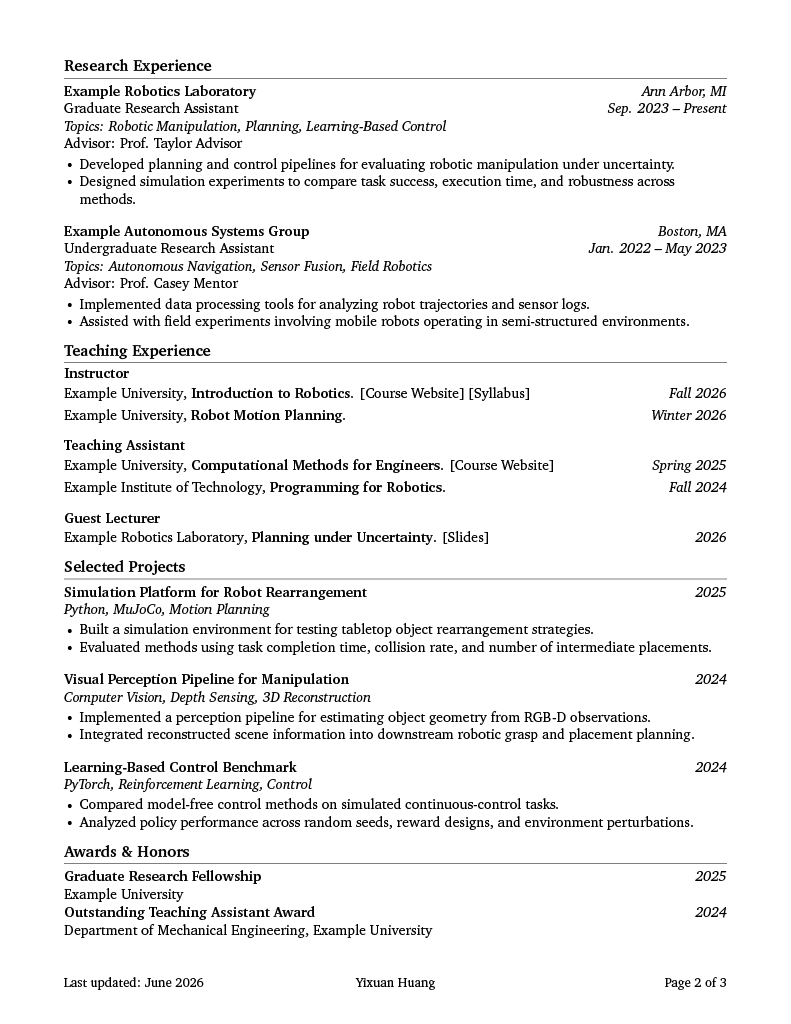
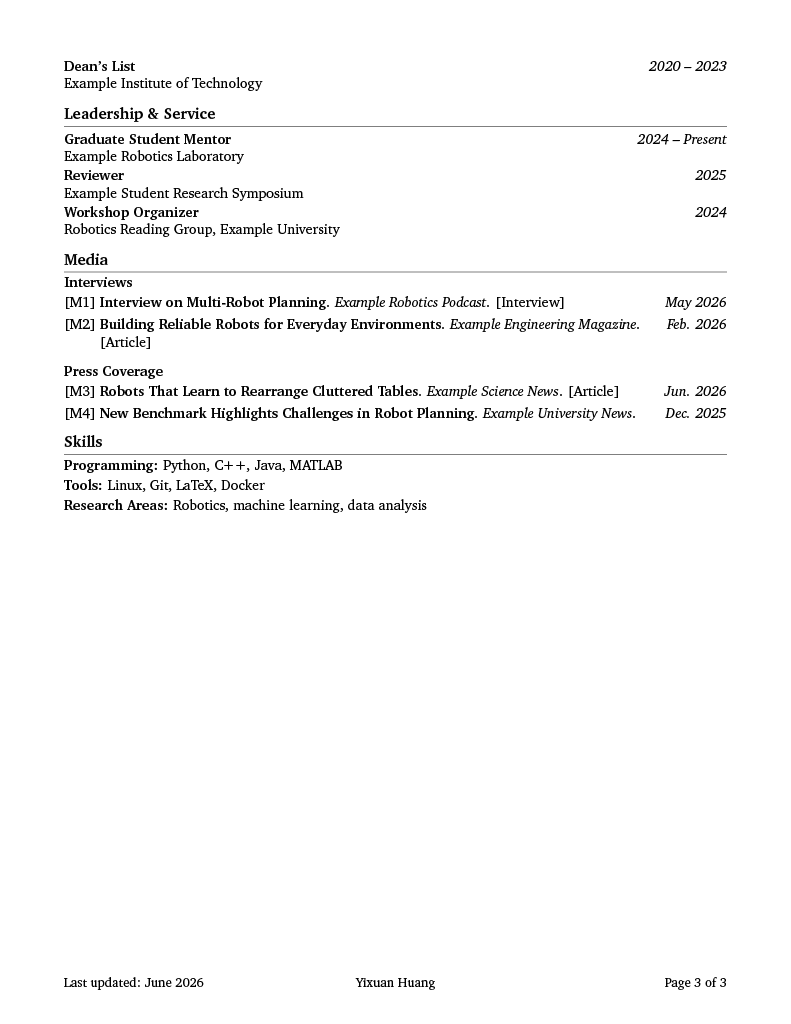
The preview below shows selected pages from the academic CV example generated with Vectra.
Examples#
Example source files are available in:
Compiled example PDFs are available here:
The academic CV example demonstrates:
- Publications with groups, notes, indexed labels, locations, and inline links
- Talks with indexed labels and right-aligned dates
- Media entries for interviews and press coverage
- Teaching entries grouped by role
- Adaptive right-side metadata columns
- Customizable header links and constrained header width
Usage and Generated Documents#
Vectra is open-source software distributed under the LaTeX Project Public License 1.3c or later.
You may use and modify the template for your own CV or resume. Documents generated with Vectra belong to their authors and do not need to display a Vectra notice, citation, watermark, or license merely because the template was used to produce them.
Modified template versions must comply with the LPPL, identify their changes, and avoid implying that they are an official Vectra release. See the plain-language license guide for details.
Features#
- Clean academic CV design
- Modular section files
- Simple user-editable profile file
- Fixed professional layout
- Consistent entry formatting
- Research-oriented section structure
- Optional generated-date handling
- Footer system with support for update date, name, and page number
- PDF metadata support
- Print-friendly link styling
- Adaptive right metadata columns
- Indexed compact publication records
- Publication groups and publication notes
- Talk entries with indexed labels and right-aligned dates
- Media entries for interviews, press coverage, podcasts, and articles
- Role-grouped teaching entries with right-aligned terms
- Inline bracket-style links for publications, talks, media, and teaching
- Configurable header width
- Custom header contact links
- Maintainer-facing design parameters separated from user-facing content
Repository Structure#
vectra/
├── README.md
├── LICENSE
├── NOTICE
├── /projects/vectra/licensing/
├── CONTRIBUTING.md
├── CITATION.cff
├── CHANGELOG.md
├── Makefile
├── latexmkrc
├── .gitignore
│
├── src/
│   ├── vectra.cls
│   ├── vectra-core.sty
│   ├── vectra-design.sty
│   ├── vectra-layout.sty
│   ├── vectra-sections.sty
│   ├── vectra-header.sty
│   ├── vectra-footer.sty
│   ├── vectra-fonts.sty
│   ├── vectra-colors.sty
│   └── vectra-accessibility.sty
│
├── cv/
│   └── README.md
│
├── examples/
│   ├── minimal/
│   └── academic-cv/
│
├── docs/
│   ├── quick-start.md
│   ├── user-guide.md
│   ├── maintainer-guide.md
│   ├── style-rationale.md
│   ├── license-guide.md
│   └── assets/
│
└── output/
Requirements#
- pdfLaTeX
latexmk- A current LaTeX distribution such as TeX Live, MacTeX, or MiKTeX
Vectra uses pdfLaTeX as its default compiler. The included latexmkrc and
Makefile provide the maintained build configuration.
Overleaf#
- Download or package the repository as a
.ziparchive. - In Overleaf, select
New Project→Upload Project. - Upload the archive.
- Set the compiler to
pdfLaTeXin the project settings. - Copy an example into
cv/, or set the selected example'smain.texas the main document.
The repository does not currently publish an official Overleaf Gallery template. The GitHub repository remains the maintained source.
Quick Start#
The public Vectra repository does not track personal CV source files in cv/.
To create your own local CV, copy one of the examples into cv/:
cp -r examples/academic-cv/* cv/
Then edit:
cv/profile.tex
cv/settings.tex
cv/sections/
1. Edit your profile#
Open:
cv/profile.tex
Update your:
- Name
- Website
- GitHub
- ORCID, if applicable
- LinkedIn, if applicable
- Location, if desired
- PDF metadata
You may also add custom header links:
\VectraAddContactLink{Google Scholar}{https://scholar.google.com/}
\VectraAddContactLink{Lab}{https://example-lab.org}
You may constrain the header width:
\VectraSetHeaderWidth{0.86\textwidth}
2. Edit your CV content#
Open files under:
cv/sections/
Edit sections such as:
- Education
- Research interests
- Research experience
- Publications
- Talks
- Teaching experience
- Media
- Projects
- Awards and honors
- Leadership and service
- Skills
- Certifications
3. Adjust simple document settings#
Open:
cv/settings.tex
This file is for simple content-level settings, such as whether the footer date uses the current compile date or a fixed update date.
Vectra is not intended to be customized by changing fonts, spacing, margins, or layout internals.
4. Compile#
From the repository root, run:
make cv
The generated PDF will be placed in:
output/
You may also compile cv/main.tex directly using a LaTeX editor or Overleaf,
provided that the project structure is preserved.
What Users Should Edit#
Users should edit:
cv/profile.tex
cv/settings.tex
cv/sections/*.tex
These files contain personal CV information and content.
What Users Should Not Edit#
Users should not edit:
src/
cv/main.tex
Makefile
latexmkrc
The files in src/ define the Vectra template design and layout. They are part
of the Template Source and are not intended for user customization or
redistribution.
Academic Record Formats#
Vectra supports indexed compact records for scholarly and public-facing content.
Publications#
[C1] Authors. Title. Venue, Year. Location. [Links]
Talks#
[T1] Title. Event, Location. [Links] Date
Media#
[M1] Title. Outlet. [Links] Date
Teaching#
Role
Institution, Course Title. [Links]         Term
These formats are designed to remain compact while supporting long academic records.
Design Philosophy#
Vectra follows a compact academic design philosophy.
The default style is intended to be:
- Professional
- Academic
- Minimal
- Readable
- Consistent
- Print-friendly
- Suitable for research-oriented applications
Vectra avoids:
- Decorative sidebars
- Excessive icons
- Overly colorful layouts
- Complex multi-column resume designs
- Manual spacing in user content
- User-facing typography customization
The goal is to let users focus on CV content while the template handles visual consistency.
Footer Design#
Vectra includes a structured footer system.
The footer may include:
- Last updated date
- Name
- Page number
The intended default academic footer format is conceptually:
Last updated: <date> <Name> Page X of Y
This provides useful version information while keeping the document formal and balanced.
Documentation#
Additional documentation is available in:
docs/
Recommended reading:
/projects/vectra/quick-start//projects/vectra/user-guide//projects/vectra/design//projects/vectra/licensing/
Maintainer-facing design notes are available in:
/projects/vectra/maintainer-guide/
This file explains internal design parameters such as spacing, margins, footer layout, adaptive metadata columns, and typography. These settings are not part of the public user API.
Citation#
If you use Vectra and want to recommend or share the template, please cite or link to the official repository:
Yixuan Huang. Vectra: Versatile Experience and Career Template for Research and
Academia. GitHub repository: https://github.com/yixnhuang/vectra
A CITATION.cff file is provided so GitHub can generate a citation through
Cite this repository. Citation is appreciated when sharing or discussing
Vectra, but it is not required inside a generated CV or resume.
Project Status#
Active. Vectra is maintained as a structured template system with versioned documentation, examples, citation metadata, and a changelog.
Contributing#
Questions, compatibility reports, documentation corrections, and focused improvements are welcome. Please open an issue before preparing a substantial change so its scope and design can be discussed.
Thank you to everyone who uses Vectra, shares thoughtful feedback, and recognizes the work behind the project. Your attention and practical experience help make the template more reliable and useful.
See CONTRIBUTING.md for contribution guidelines.
License#
Vectra is distributed under the LaTeX Project Public License, version 1.3c or later.
This work has the LPPL maintenance status maintained. The Current Maintainer
is Yixuan Huang. Generated documents are not required to use the LPPL or display
attribution solely because they were produced with Vectra.
See NOTICE and /projects/vectra/licensing/ for project-specific clarifications.
Contact#
For questions or collaboration, use the contact details below or consult the website for the latest information.
- Website: yixuanhuang.com
- Email: yixhuang@umich.edu